The Screen as a Rule
A referee screen is not furniture. It hides information and makes certain results renegotiable — which means it is a mechanism, whether or not anyone names it that.
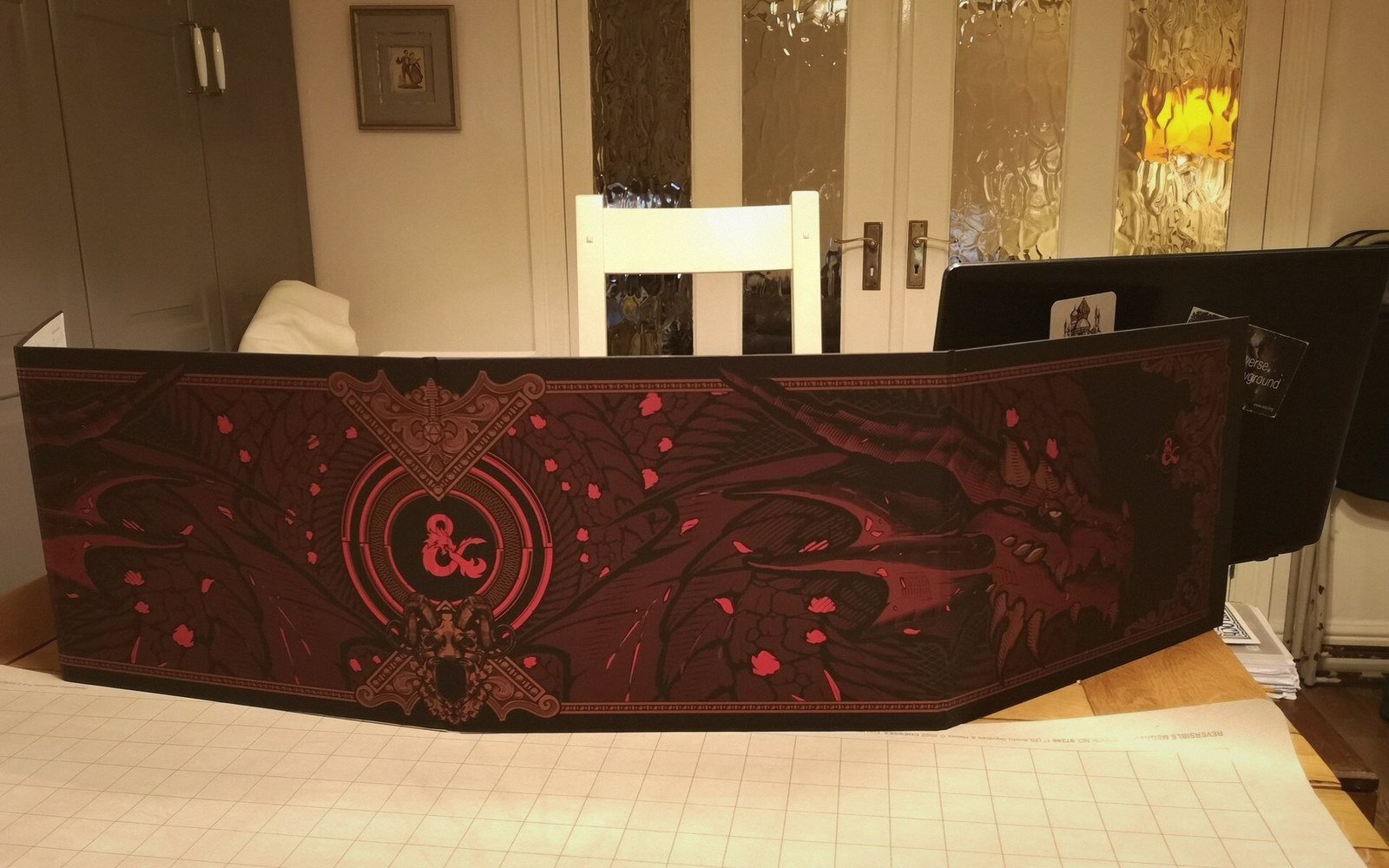
01What the cardboard actually does
Place a rectangle of cardboard between the referee and the players and two things happen simultaneously. First, the referee's dice become unwitnessed. A roll behind the screen exists in a quantum state until the referee announces it — which means the referee can announce something other than what landed. Second, the tables and charts printed on the facing side of that cardboard are now always in the referee's line of sight. These are not decorative effects. They are design decisions with mechanical consequences.

The mechanism at a glance
- 01Hidden roll — a die result unwitnessed by players remains adjustable until announced; this softens the effective probability floor
- 02Reference surface — charts kept in the referee's eyeline reduce lookup time; pure interface function
- 03Unwitnessed vs. witnessed result — the distinction that makes the screen a mechanical object, not only a prop
The hidden roll is the sharper of the two. An unwitnessed die roll is not the same probability event as a witnessed one. When players can see the result, the number is fixed the moment it lands. When they cannot, the referee holds an option: report truthfully, or override. Most referees override rarely or never, and they would be right to call this good GMing. But "rarely" is not "never," and even a low-probability override changes the table's relationship to randomness. Players who know results can be adjusted — even if only to save a campaign from a catastrophic string of bad luck — are playing a game with a softer probability floor than the dice alone would produce.

This is not necessarily wrong. The interesting question is whether the table is honest with itself about what it has chosen. A referee who runs with a screen and freely adjusts rolls has made a curatorial decision about the fiction: the story matters more than the algorithm. That is a coherent position. A referee who insists the screen is purely for reference cards while quietly correcting outcomes is running a different game than the one described at the table — one where the randomness is presented as binding but is not.
But it shares a physical object with the hidden-roll function, and the two cannot be fully separated.
The reference-card function is real and useful. Keeping common target numbers, condition summaries, and damage tables in the referee's line of sight shortens lookup time and keeps the game moving. That is interface design, not deception. But it shares a physical object with the hidden-roll function, and the two cannot be fully separated.

Running without a screen forces accountability: every result is a witnessed fact. Some referees prefer exactly this. What it costs is the option to silently absorb the outlier that would end the session on a hollow note. What it gains is a table that trusts its own dice.
The screen is a policy choice. Name it as one.